
Thomas Jefferson–Sally Hemings Paternity Question: A Critical Analysis of the Conception-Window Theory
Introduction
The question of whether Thomas Jefferson fathered the children of Sally Hemings has, in recent decades, been shaped largely by interpretations of the 1998 Y-DNA study and a statistical “conception-window” model developed by Frasier D. Neiman, Monticello’s Director of Archeology, rather than by a specialist in population statistics or genetic epidemiology.[1] Because the analysis appeared in a historical publication rather than a peer-reviewed scientific journal, its statistical assumptions have not undergone the type of independent methodological scrutiny typically expected for probabilistic modeling. Although Neiman’s conception window model has frequently been cited as indicating a very high likelihood that Jefferson fathered Eston Hemings — and, by implication, Sally Hemings’ other children — its conclusions rest on several assumptions that warrant closer examination. These include interpretations of Jefferson’s documented presence during certain conception periods, the assumption that no other Jefferson-line males present at Monticello could have fathered the various children, the documented availability of alternative male candidates at or near Monticello, and eyewitness testimony that has not been fully accounted for in the conception window model’s framework. The original analysis also did not incorporate Jefferson’s age-related fertility decline or his documented episodes of illness and physical limitations during the relevant period — biological and demographic variables that materially affect any comparative assessment of paternity. When these factors are considered together, the conception-window model appears less definitive than often presented and merits careful reexamination rather than categorical certainty.
I. Gaps in Jefferson’s Recorded Presence During Estimated Conception Periods
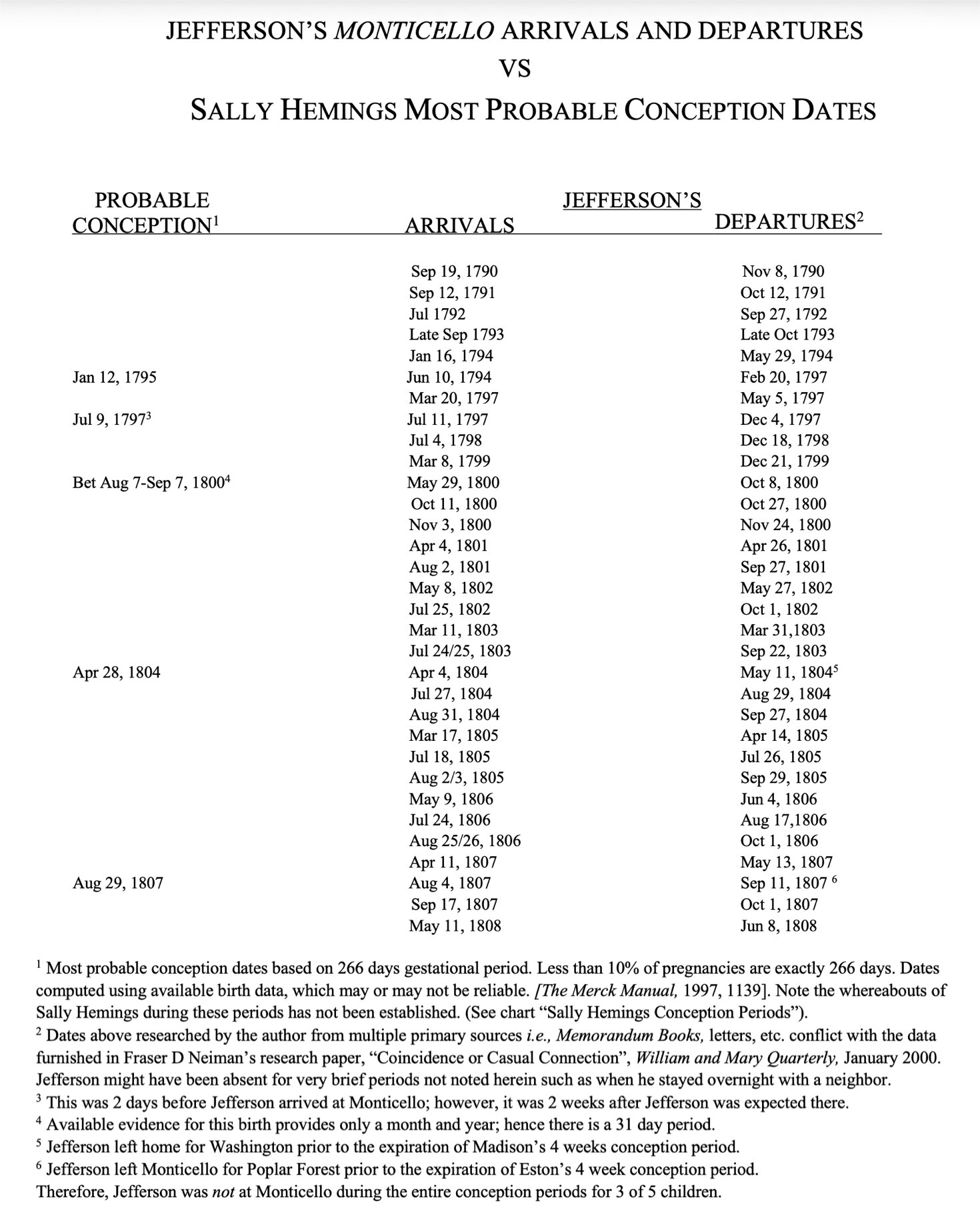
The statistical argument depends upon Jefferson’s documented presence at Monticello during each estimated conception window. Critics have noted that this presence was not always continuous.
As summarized in the Report of the Scholars Commission by science writer Steven Corneliussen of the Thomas Jefferson National Accelerator Facility:
“Jefferson’s presence for less than 50 percent of the window in [Beverly Hemings’] case means an overall probability of less than 50 percent for Jefferson’s presence in all six. So just by itself, this one absence upends the entire study.”[2]
Further, regarding Eston Hemings:
“Jefferson visited ‘Bedford’ in September 1807 — presumably shortly after Eston was conceived, but overlapping the projected conception window.”[3]
Statisticians argue that if Jefferson was absent during portions of relevant conception windows—including for Eston, the only child genetically linked to a Jefferson-line male—then the statistical inference of inevitability is significantly weakened.
The conception window model measures correlation between documented residence and estimated conceptions. It does not eliminate the possibility that conception occurred during periods of Jefferson’s absence.
In addition, the same visitation record used to construct the conception-window inference contains a counter-pattern rarely acknowledged in popular summaries. As the Scholars Commission observed:
[B]etween the years of her first conception and the birth of her last child, Thomas Jefferson came to Monticello more than twenty times, and Sally Hemings is believed to have become pregnant only about five or six times. Why did she become pregnant within days of his arrival on some occasions, and not become pregnant when on other occasions he returned and stayed months at a time? Why, if the alleged relationship began in Paris, did it take her more than five years to conceive a second child? Why did Sally [Hemings] stop having children when Thomas Jefferson returned permanently to Monticello?[4]
If presence is treated as powerful evidence when a pregnancy follows, the repeated non-events must likewise be considered part of the evidentiary record. The calendar does not show that Jefferson’s return reliably predicted conception; rather, it shows that conception sometimes followed his presence—and more frequently did not.
Source: Jefferson Vindicated, by Cynthia H. Burton
II. The Monogamy Assumption in the Conception Window Statistical Model
The circumstantial case is largely premised upon the assumption of an exclusive relationship. However, there is no direct documentary evidence establishing exclusivity between Jefferson and Sally Hemings. In fact, many of the Hemings family women had children with more than one man. Madison Hemings himself acknowledged that Sally Hemings’ own mother (his grandmother) Betty Hemings “had seven children by white men and seven by colored men — fourteen in all.”[5]
Two of Sally Hemings’ sisters each had multiple children with multiple fathers. For example, her older half-sister Bett was the mother of eight children by multiple men.[6] As the former slave Henry Bibb wrote in 1849: “It is almost impossible for slaves to give a correct account of their male parentage....”[7] None of this proves that Sally Hemings herself had multiple partners. It does, however, undermine any presumption that monogamy should be assumed without evidence.
In the 1998 study, DNA excluded the Carr nephews (Peter and Samuel) only for Eston Hemings — not for Sally Hemings’ other children such as Madison Hemings. Jefferson’s grandchildren maintained that the father of Sally Hemings' children was Peter Carr, who even confessed on more than one occasion. Peter Carr was only 2–3 years older than Sally Hemings, grew up at Monticello with her, and later lived within a horse ride of Monticello.
The statistical conception window model does not test exclusivity. Instead it presumes it. The Scholars Commission points out “there is no reason to assume that Sally Hemings was monogamous. We simply do not know.”
Without the assumption of monogamy, the correlation between her pregnancies and Thomas Jefferson’s visits to Monticello (which would obviously trigger visits by his friends and relatives) is of limited probative value in the search for the paternity of Eston Hemings or any of Sally [Hemings’] other children. [8]
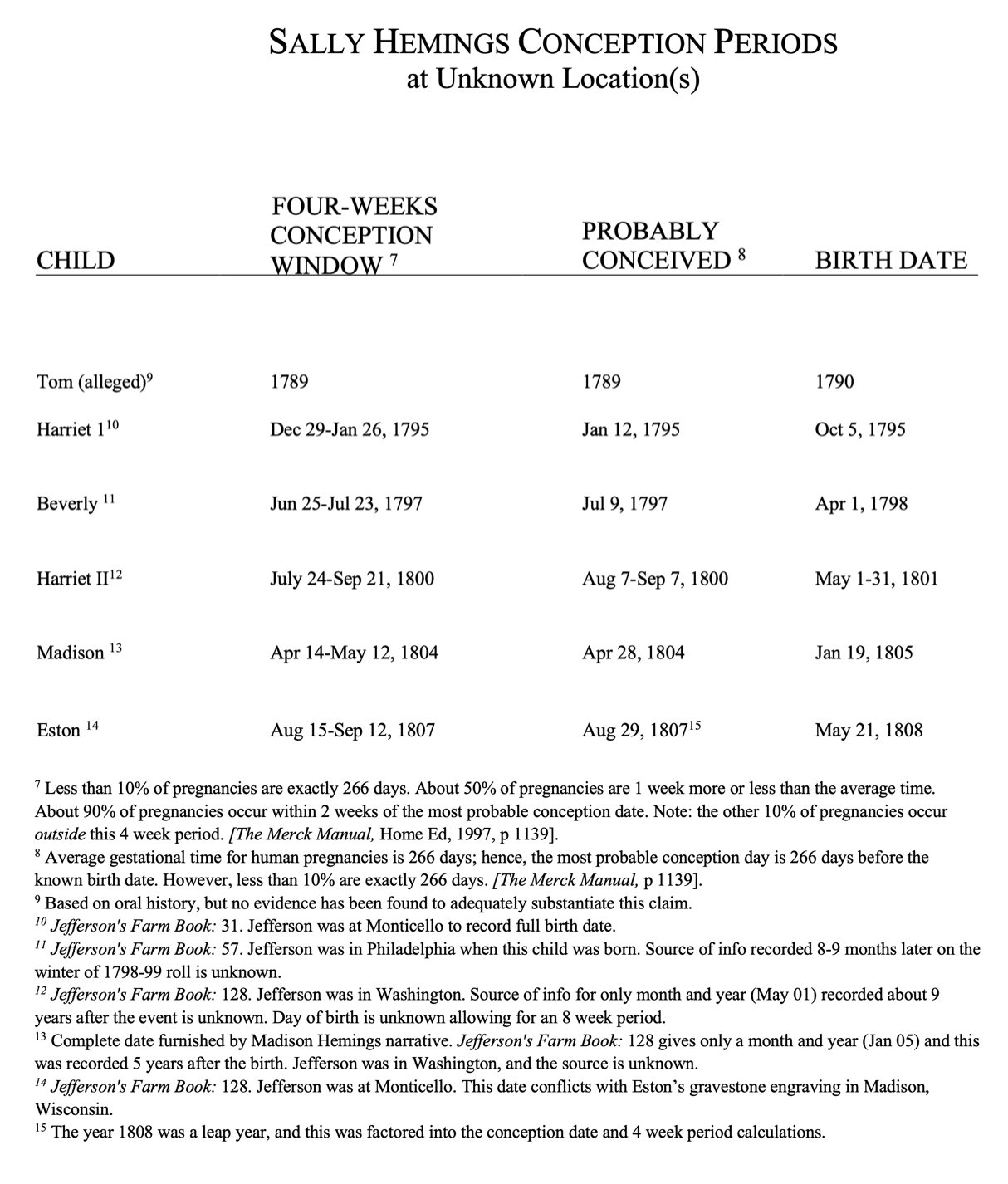
A further timing pattern likewise complicates a simple “presence equals causation” interpretation. Monticello’s own appendix lists Eston Hemings, born 21 May 1808, as the last of Sally Hemings’ children.[9] Thomas Jefferson left the presidency in March 1809 and returned to private life, returning to retire at Monticello.[10] During this phase of his life, Jefferson generally remained at Monticello.[11] Yet, as Cynthia Burton notes in summarizing the research record:
It is believed by most researchers that Sally [Hemings] never conceived again after Eston’s birth in 1808, and when Jefferson retired and returned home for good. In 1809, Sally Hemings was about 36 years old – 6 years younger than her mother was when she had her last child.”[12]
This pattern does not conclusively resolve the question of paternity. It does, however, caution against treating Jefferson’s presence alone as the central explanatory variable, because the correlation does not continue when his presence becomes most constant.
Source: Jefferson Vindicated, by Cynthia H. Burton
III. Thomas Jefferson’s Age, Fertility, and the Biological Plausibility of Paternity
Neiman’s conception window model is a coincidence-of-dates framework that does not incorporate an analysis of age-related fertility decline. Thomas Jefferson was 64 years old when Eston Hemings was conceived. In a cross‑sectional study of all U.S. live births from 2011–2022, births to men ≥60 accounted for 0.1%. At the same time, Jefferson’s younger brother Randolph Jefferson was 51 years old, and the same study showed that men his age had ten times the share of live births.[13] These figures are not a conclusion about any individual case, but they are highly relevant when a statistical claim is presented as near‑certainty—because they describe how rarely “a man in his sixties is the father” before any additional evidence is considered.
Put plainly: in contemporary population terms, the chance of fatherhood at 60+ is on the order of one birth in a thousand. This birth rate study was conducted in an era of modern medicine and increased life expectancy — both luxuries unavailable in 1807. In addition, the study noted that modern older‑father births are disproportionately associated with assisted reproductive technology (ART); the study finds increasing paternal age is consistently associated with greater ART use.[14] Thus, modern “≥60 fatherhood” rates include births made possible or more likely through assisted reproductive technology — medical interventions unavailable in 1807. However, Neiman did not take any of this into consideration in his statistical conception window model, treating the fatherhood base rate as essentially constant across decades of age.
The historical record does not establish sterility for Jefferson; in the materials reviewed, no direct statement by Jefferson or contemporaries asserts infertility. What does exist are recurring, dated expressions of illness and physical limitations around the relevant periods. In the period 1807–1808, Jefferson suffered from debilitating migraines and attacks of rheumatism that left him scarcely able to walk.[15][16] These ailments do not speak to fertility directly. They do, however, reinforce a modest but important inference: Jefferson’s early sixties were marked by documented episodes of illness and physical limitations, and a conception window model that assumes equal reproductive capacity across age is ignoring a significant real‑world variable.
By contrast, Randolph Jefferson’s late‑life fertility is documented. Randolph conceived his last son, John Randolph Jefferson, in mid-June 1815, when he was 59. Randolph’s fertility at the time of the conception of Eston Hemings in 1807 is therefore established, yet Randolph was never considered in Neiman’s conception window model.
Just six weeks before the conception of Eston Hemings, Thomas Jefferson was suffering from rheumatic pain in his leg. A doctor had recommended vinegar-soaked bandages. Former Monticello slave Isaac Granger Jefferson described the scene:
About the time when my Old Master begun to wear spectacles, he was took with a swellin’ in his legs; used to bathe ’em and bandage ’em; said it was settin’ too much. When he’d git up and walk it wouldn’t [sic?] hurt him. Isaac and John Hemings nursed him two months; had to car[t] him about on a han’barrow.[17]
The Scholars Commission notes that this does not necessarily prove that Thomas Jefferson could not have fathered one or more of Sally Hemings’ children.
But it is relevant to our inquiry, and along with the other data we have, it greatly reduces the probability that Thomas Jefferson was more likely than his much younger brother or nephews (or someone else) to have fathered Eston Hemings.[18]
The evidentiary weight is therefore straightforward. The record supports Jefferson’s age (64), Randolph’s age (51), Randolph’s documented late paternity (1816 birth), and modern base rates showing how uncommon fatherhood is at 60+. While the record does not support a claim that Jefferson was sterile, the proper conclusion is narrower but still consequential: a conception windowmodel that omits paternal‑age priors and documented fertility differences is incomplete, and its characterization of the conclusion as approaching certainty should be evaluated in light of those omissions.
Much of this would have been borne out in a rigorous, independent peer review process to ensure quality and validity before publication. However, by publishing Neiman’s conception window model in a historical magazine rather than a peer-reviewed scientific journal, the standard scientific review process was bypassed and thus its accuracy and underlying assumptions were not subjected to independent methodological scrutiny prior to publication.
IV. Edmund Bacon’s Eyewitness Account and Alternative Male Access at Monticello
One of the most significant human elements in this controversy is the recollection of Edmund Bacon, overseer at Monticello from 1806 to 1822.[19]
In Jefferson at Monticello: The Private Life of Thomas Jefferson, Bacon stated:
“[Jefferson] freed one girl some years before he died, and there was a great deal of talk about it. She was nearly as white as anybody and very beautiful. People said he freed her because she was his own daughter. She was not his daughter; she was ________’s daughter. I know that. I have seen him come out of her mother’s room many a morning when I went up to Monticello very early.”[20]
Importantly, Bacon’s published memoirs did not include the man’s name. Reverend Hamilton Pierson, who recorded the interview, explained that he omitted certain names and facts “in regard to the intemperance, and other vices… of some who were connected with Mr. Jefferson’s family.”[21]
While Bacon’s recollections were recorded decades after the events, they constitute eyewitness testimony from a man physically present during the period when Eston Hemings was conceived. The conception-window model does not incorporate such testimony.
V. Evaluating the Reliability of Madison Hemings’ 1873 Narrative
Madison Hemings’ 1873 interview remains central to interpretation. Yet scholars have long cautioned against treating it as definitive.
As noted by the Scholars Commission:
“Madison Hemings’ ‘Memoir,’ which is actually a reporter’s account of an interview with him, first published in an Ohio newspaper in 1873, is entitled to the same respect and should be considered with the same skepticism… In this case, many of its details can be corroborated… Some can be disproved… he could not have known first-hand who was the father of Sally [Hemings’] children or whether all of them were fathered by the same man.”[22]
Further analysis emphasizes internal inconsistencies:
There are substantial inaccuracies and unverifiable statements… inconsistent with proven facts thereby weakening its credibility.” [23] [24]
Madison Hemings never attributes the source of his account to his mother Sally Hemings, which would have bolstered his claims, but rather is quoted, "Such is the story that comes down to me.”[25] His account was taken down and edited by an abolitionist reporter (Samuel Wetmore). The Scholars Commission found other problems with his account, including the use of language traceable to prior publications:
[Madison Hemings] provides no source for his alleged statements. Some sentences in his account pertain to aspects of Jefferson’s background that occurred long before Madison was born and that had been mentioned in published biographies of Jefferson. Several unusual words can be traced directly back to the 1802 [James] Callender attacks on Jefferson, including the identical misspelling of a name. Madison was also reported as saying that Dolley Madison was present at the time of his birth, and numerous reliable documents strongly suggest that this statement is false.[26]
Thus, while Madison Hemings’ account is valuable, it is not entirely reliable. Therefore, his statements “do not outweigh the contradictory eyewitness accounts of others that exist on many of these issues.” [27]
VI. Randolph Jefferson and Other Jefferson-Line Males at Monticello
Former Monticello slave Isaac Granger Jefferson provided an eyewitness description of Thomas Jefferson’s younger brother Randolph Jefferson:
“Old Master’s brother, Mass Randall, was a mighty simple man: used to come out among black people, play the fiddle and dance half the night; hadn’t much more sense than Isaac.” [28]
The Scholars Commission further notes:
“We also have reliable testimony by former slave Isaac Jefferson that Randolph was fond of spending his evenings at Monticello playing his fiddle with the slaves and dancing ‘half the night.’ … We have a letter from Thomas Jefferson, dated August 12, 1807, inviting Randolph to visit Monticello — and this was about a week before the start of the three-week window during which it is estimated that Sally [Hemings] conceived Eston.” [29]
Randolph lived approximately twenty miles from Monticello. The timing of the invitation suggests Randolph’s presence at Monticello squarely within the conception window for Eston Hemings.
Again, none of this proves Randolph’s paternity. But it does demonstrate that multiple Jefferson-line males were plausibly present during overlapping conception windows, which the conception-window model excludes.
VII. Statistical Methodology and the Publication of the Conception Window Analysis
The statistical study underpinning the conception-window theory was published in The William and Mary Quarterly, a respected historical journal.[30] However, it was not published in a scientific or medical journal specializing in statistical modeling. Science writer Corneliussen described how the editors of the humanities journal William and Mary Quarterly extended beyond their traditional editorial mandate by publishing a scientific study outside of both their mandate and capacity as historians for proper scientific evaluation and oversight:
In my view, when the William and Mary Quarterly made itself a venue for science, it became obligated to require science’s common practices [such as technical review]... Among the study’s deficiencies is one problem so fundamental that, just by itself, it cancels any possibility of the study contributing usefully. By failing to apply an obviously necessary biostatistical technique, Neiman failed to account for the distinct statistical chance—in one case, greater than fifty percent chance—that at the time of conception in four of the six cases Neiman designated for study, Jefferson could actually have been absent from Monticello.[31]
While the choice of publication venue alone does not invalidate conclusions, the absence of statistical peer review is relevant when evaluating probabilistic claims presented as scientific confirmation.
VIII. Institutional Dynamics and the Presentation of the Statistical Findings
Ken Wallenborn, a member of Monticello’s Research Committee who said he later felt compelled to file a minority report, described the atmosphere in which the Monte Carlo analysis was introduced. He recalled:
“When the committee was assembling for one of its meetings in February 1999, the head of the Archaeology Department at Monticello [Frasier Neiman] dropped a packet of papers on the table next to me and said (and this is exactly how another member of the committee and I recollect it): “I’ve got him!” He repeated this statement again and then explained his ‘Monte Carlo Simulation.’ This just seemed to be an inappropriately enthusiastic remark for someone who is working at Thomas Jefferson’s home.”[32]
Wallenborn further stated that his minority report containing his dissenting analysis was not distributed to all committee members prior to publication, nor was it included with the final report presented to the press.[33]
While such recollections do not invalidate statistical analysis, they raise legitimate questions about institutional posture and the neutrality of the investigative process.
FREQUENTLY ASKED QUESTIONS
Did DNA prove that Thomas Jefferson fathered Sally Hemings’ children?
No. The 1998 DNA study did not identify Thomas Jefferson as the father of any of Sally Hemings’ children. It established only that a male in the Jefferson paternal line fathered Eston Hemings. The Y-chromosome evidence cannot distinguish among male members of the Jefferson family who shared the same paternal line.
Following publication, the study’s authors clarified that other Jefferson-line males — including Randolph Jefferson and his sons — remained possible candidates. The DNA results narrowed the field; they did not resolve the paternity question.
Did the conception-window theory scientifically prove Jefferson’s paternity?
No. The conception-window theory is a statistical correlation model, not biological proof. It argues that Thomas Jefferson’s documented presence at Monticello during estimated conception periods makes paternity highly probable.
However, critics have pointed out that the conception window model:
Did not fully account for Jefferson’s absences during portions of key conception windows
Did not incorporate the documented presence of alternative Jefferson-line males
Relied on a fixed three-week window despite biological variability
Assumed exclusivity rather than testing it
Was not properly independently peer-reviewed before publishing
The conception window model measures coincidence of dates; it does not establish causation or eliminate alternative fathers.
Was Randolph Jefferson present during Eston Hemings’ estimated conception period?
Documentary records show that Thomas Jefferson invited his brother Randolph to Monticello on August 12, 1807 — approximately one week before the beginning of Eston Hemings’ projected conception window.
Former slave Isaac Jefferson also described Randolph as frequently spending evenings with the enslaved community at Monticello socializing, playing his fiddle, and remaining late into the night.
While this does not prove Randolph’s paternity, it demonstrates that another Jefferson-line male was plausibly present at Monticello during the critical conception window timeframe — a factor not incorporated into the conception-window statistical model.
Why is Jefferson’s constant presence after 1809 relevant?
Thomas Jefferson retired from the presidency in 1809 and thereafter generally remained at Monticello. Yet Sally Hemings is not known to have borne any additional children after Eston’s birth in 1808.
If Jefferson’s presence is treated as the primary explanatory factor for earlier conceptions, the cessation of childbearing once his presence became most consistent raises questions that deserve consideration. The pattern does not by itself resolve the paternity question, but it complicates a simple “presence equals causation” interpretation.
How many times did Jefferson return to Monticello without a resulting pregnancy?
Historical records indicate that Jefferson returned to Monticello more than twenty times during the years when Sally Hemings bore her known children, yet pregnancies occurred only five or six times.
If the alignment of arrival dates with pregnancies is treated as strong evidence of paternity, the repeated non-events must also be considered. The visitation record does not show that Jefferson’s presence reliably predicted conception.
Footnotes
Frasier D. Neiman, “Coincidence or Causal Connection? The Jefferson-Hemings Controversy Revisited,” William and Mary Quarterly 57, no. 1 (2000): 198–206.
Robert F. Turner et al., The Jefferson-Hemings Controversy: Report of the Scholars Commission (Carolina Academic Press, 2011), 377.
Ibid, 235
Ibid. 17.
S. F. Wetmore & Madison Hemings, Life Among the Lowly, No. 1, March 13, 1873, Pike County Republican (Waverly, Ohio).
Cynthia H. Burton, Jefferson Vindicated (Self-published, 2005), 107.
Lucia Stanton, SLAVERY AT MONTICELLO 21 (1996)
Robert F. Turner et al., The Jefferson-Hemings Controversy: Report of the Scholars Commission (Carolina Academic Press, 2011), 134.
Thomas Jefferson Memorial Foundation Research Committee, Report on Thomas Jefferson and Sally Hemings (Charlottesville: Thomas Jefferson Memorial Foundation, 2000), Appendix H (listing “21 May 1808 (Eston)” among the known births).
“About the Series,” The Papers of Thomas Jefferson: Retirement Series, noting that the series begins with Jefferson’s “return to private life on 4 March 1809.”
“Brief Biography of Thomas Jefferson,” Monticello.org (noting that during the last seventeen years of his life Jefferson generally remained at Monticello).
Burton, Jefferson Vindicated, 109.
Albert S. Ha et al., “Sociodemographic Trends and Perinatal Outcomes in Fathers 50 Years and Older,” JAMA Network Open 7, no. 8 (2024): e2425269 (reporting 1.1% ≥50; 0.1% ≥60; 1.3% by 2022). https://jamanetwork.com/journals/jamanetworkopen/fullarticle/2821811
Ha et al., JAMA Network Open (2024) (finding higher ART use with increasing paternal age).
Thomas Jefferson to Martha Jefferson Randolph, 6 Mar. 1807 (“very bad cold… laid me up with a fever”); Thomas Jefferson to James Monroe, 11 Apr. 1808 (“periodical head‑ach”), in Founders Online, National Archives. https://founders.archives.gov/documents/Jefferson/99-01-02-5222
Thomas Jefferson to Ellen Wayles Randolph Coolidge, 25 Oct. 1808 (“attack of rheumatism… can scarcely walk”), in Founders Online, National Archives. https://founders.archives.gov/documents/Jefferson/99-01-02-8943
Isaac [Granger] Jefferson, Life of Isaac Jefferson of Petersburg, Virginia, Blacksmith, aka Memoirs of a Monticello Slave, 1847 (UVA). Turner et al., Report of the Scholars Commission, 254.
Robert F. Turner et al., The Jefferson-Hemings Controversy: Report of the Scholars Commission (Carolina Academic Press, 2011), 254.
Hamilton Pierson & Edmund Bacon, Jefferson at Monticello: The Private Life of Thomas Jefferson, 1862.
Ibid.
Ibid
Turner et al., Report of the Scholars Commission, 272.
Burton, Jefferson Vindicated, 163.
Ibid, 91.
S. F. Wetmore & Madison Hemings, Life Among the Lowly, No. 1, March 13, 1873, Pike County Republican (Waverly, Ohio).
Turner et al., Report of the Scholars Commission, 8-9.
Ibid, 9.
Isaac [Granger] Jefferson, Life of Isaac Jefferson of Petersburg, Virginia, Blacksmith, aka Memoirs of a Monticello Slave, 1847 (UVA). Turner et al., Report of the Scholars Commission, 228.
Turner et al., Report of the Scholars Commission, 163.
Frasier D. Neiman, “Coincidence or Causal Connection? The Jefferson-Hemings Controversy Revisited,” William and Mary Quarterly 57, no. 1 (2000): 198–206.
Corneliussen, Steven. Sally Hemings, Thomas Jefferson, and the Authority of Science.
Ken Wallenborn, The Jefferson-Hemings Myth, 63.
Ibid, 63-67.